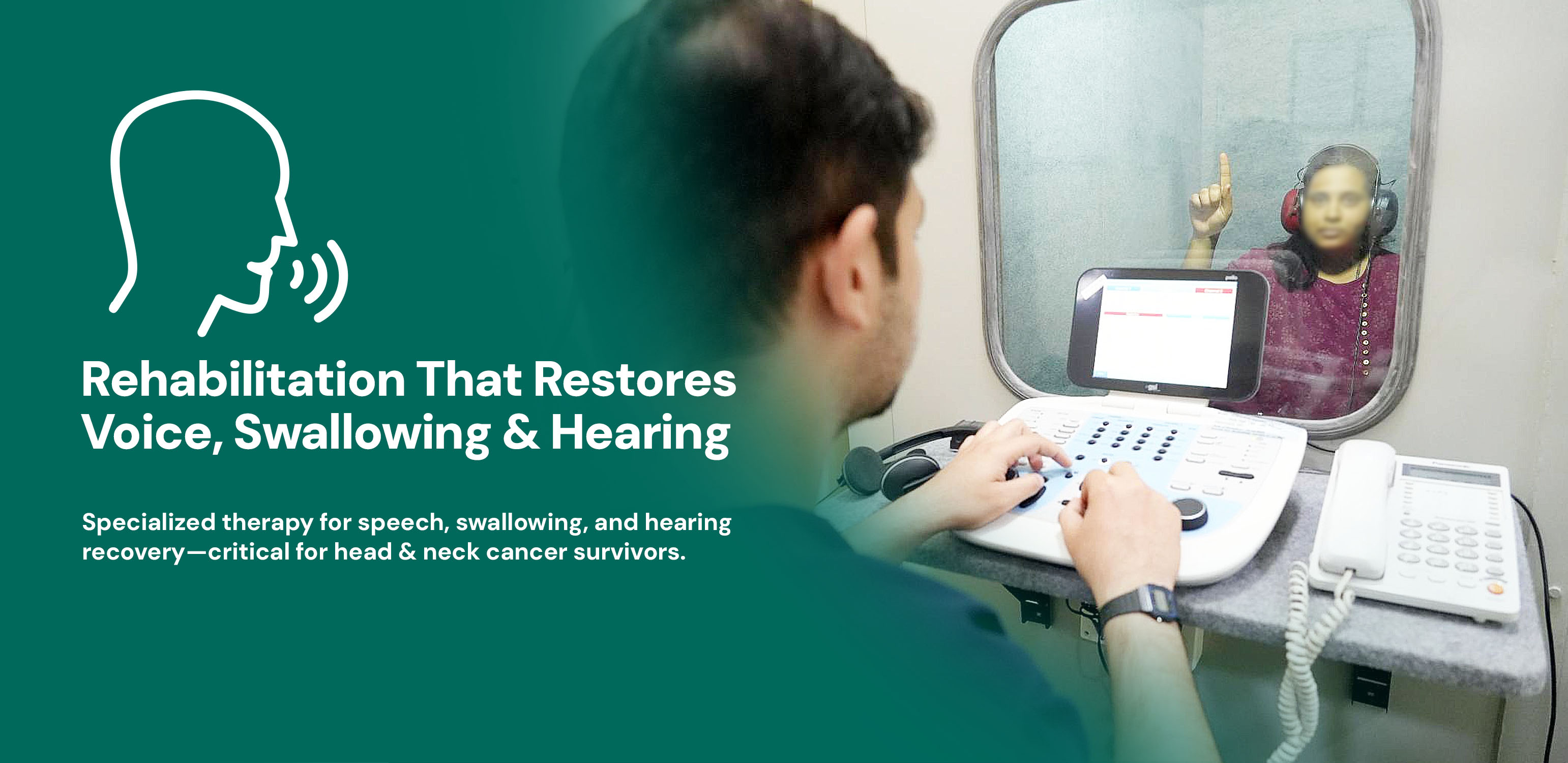
The Speech and Swallow Therapy Department provides specialized rehabilitation to restore critical communication and swallowing functions impaired by cancer and its treatment.
Cancer treatments, particularly surgery and radiation to the head, neck, and chest, can cause complex changes to the muscles, nerves, and tissues responsible for speaking, eating, and breathing.
Our department is dedicated to restoring, maintaining, and compensating for impairments in communication and swallowing, maximizing quality of life and nutritional intake.
The mission is to restore, maintain, and compensate for impairments in communication (voice, language) and swallowing (dysphagia), thereby maximizing quality of life, nutritional intake, and social interaction.
We provide consultation before treatment begins, preparing patients for potential side effects and teaching them prophylactic exercises. This proactive approach helps preserve muscle function and minimize the severity of later swallowing difficulties.
We work closely with Nutrition, Radiation Oncology, and Head & Neck Surgery to address the impact of radiation-induced fibrosis and surgical changes on the delicate structures of the throat and mouth.
Our department utilizes a blend of advanced diagnostic tools and individualized behavioral therapy protocols to achieve optimal functional outcomes.
Focuses on improving the strength, coordination, and timing of the swallowing muscles. Therapy is guided by imaging and involves targeted exercises (e.g., Shaker or Masako maneuvers) and techniques to reduce the risk of aspiration (food or liquid entering the lungs).
Safe Eating and Drinking: We teach you exercises to strengthen the muscles in your throat and mouth. This ensures you can swallow safely, reducing the risk of choking and helping you transition off feeding tubes so you can enjoy meals again.
We use specialized, objective tests to evaluate the mechanism of swallowing: Fiberoptic Endoscopic Evaluation of Swallowing (FEES) uses a thin camera passed through the nose to observe swallowing in real-time. Videofluoroscopy (VFSS) uses X-ray video during swallowing to trace the movement of food/liquid.
Visualising the Swallow: We use a tiny, specialized camera (FEES) or X-ray video (VFSS) to see exactly why you are having trouble swallowing. This precision allows us to tailor exercises to the exact muscles that need training.
Includes therapy for voice quality changes (dysphonia) caused by vocal cord damage or paralysis. For patients who have undergone laryngectomy (removal of the voice box), we provide training for alaryngeal communication methods, such as Tracheoesophageal Puncture (TEP) speechand Electrolarynx Esophageal Speech.
Restoring Your Voice: We help you regain a strong, clear voice after treatment. Able to communicate, improve Quality of Life and can be independent.
Addresses difficulties with attention, memory, problem-solving, and language organization that can result from chemotherapy ("Chemo-Brain") or brain tumors. Therapy uses structured exercises to improve daily communication and functional skills.
Sharpening Your Mind: If cancer treatment or a brain tumor affects your memory or ability to find words ("Chemo-Brain"), we provide targeted exercises to improve your focus, memory, and organizational skills for better daily communication.
We integrate swallowing therapy into the patient's treatment schedule before radiation therapy begins. This prehabilitation protocol minimizes muscle weakness and scarring, resulting in significantly better long-term swallowing outcomes.
Our therapists possess specialized expertise in the unique challenges of cancer recovery, managing deficits caused by microvascular free flap reconstruction and the progressive fibrosis resulting from radiation.
We utilize state-of-the-art objective tools (FEES and VFSS) to accurately assess swallowing physiology, moving beyond subjective symptoms to guide highly specific, measurable treatment plans.
We work closely with Gastroenterology, Interventional Pulmonology, and Nutritionists to coordinate feeding tube placement, dietary modifications, and overall functional restoration.
Our program emphasizes the psychological component of communication and swallowing function. By providing patients the ability to eat and talk near to normal, we restore confidence, reduce social isolation, and significantly enhance overall quality of life.
Pure tone audiometry for the patients who undergo chemo and radiation (before treatment).
MSc - Audiology & Speech Language Pathology (June 2019)
Speech and Swallow SpecialistSpeech, Swallowing Therapy and Audiology