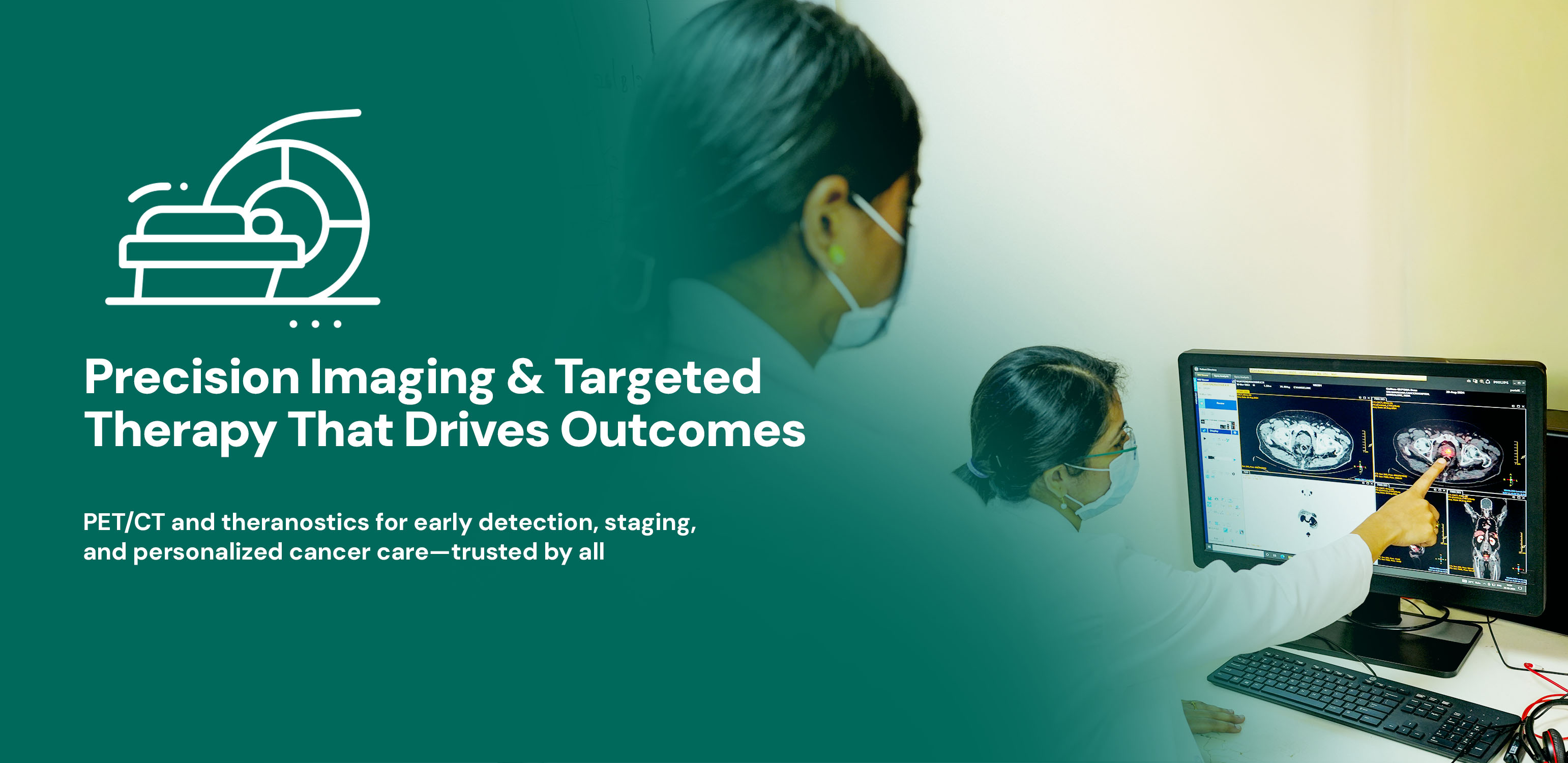
The Nuclear Medicine Department provides highly specialized, functional imaging and targeted internal radiation therapies that are integral to modern oncology. We utilize advanced equipment, including two PET/CT Scanners and a SPECT Gamma Camera, to deliver precision diagnosis (e.g., FDG, PSMA, DOTATATE PET/CT) and groundbreaking treatments like PSMA Therapy and Peptide Receptor Radionuclide Therapy (PRRT). Our core service is Theranostics, the union of diagnosis and therapy, offering highly specific, systemic treatment for metastatic cancers.
Nuclear Medicine uses trace amounts of radioactive substances (radiopharmaceuticals) to visualize organ function and molecular activity, rather than just anatomy. This provides unique insights into cancer biology (Diagnostics), and allows for the targeted delivery of therapeutic radiation (Therapeutics). It also provides key diagnostics information in cardiology and endocrinology, nephrology, neurology services.
Our department is dedicated to providing precision imaging and targeted internal radiation therapies through the innovative approach of Theranostics, combining diagnosis and treatment for optimal cancer care.
We are experts in functional imaging, mapping metabolic activity (via PET/CT) to accurately stage cancer, assess tumor response to treatment, and detect cancer recurrence.
We treat cancer by administering therapeutic radionuclides (radioactive drugs) that specifically target and destroy cancer cells while sparing healthy tissue.
We perform an average of 650 diagnostic procedures and 12 therapies every month, necessitating strict quality of care, patient safety, and compliance with established guidelines.
Our department is conceptually split into three integrated blocks: Diagnostics, Therapeutics, and the innovative union of both, Theranostics.
We use radiotracers (FDG, PSMA, DOTANOC, DOPA, FAPI) for initial staging, detection of unknown primary tumors, radiation therapy planning, and monitoring response. We also perform specialized procedures like Sentinel Lymph Node Lymphoscintigraphy and Radio-guided Occult Lesion Localization (ROLL).
Precision Mapping: We use advanced scanners (2 PET/CT Scanners) and special imaging agents (like PSMA or DOTATATE) to get a molecular picture of your body, which precisely locates cancer cells and guides the exact plan for your therapy.
Theranostics uses the same molecular pathway for both imaging and therapy to achieve high specificity in cancer management. In prostate cancer, 68Ga-PSMA PET/CT enables sensitive detection of PSMA-expressing lesions, which are then targeted using 177Lu-PSMA radioligand therapy. For neuroendocrine tumors, 68Ga-Dotatate PET/CT measures somatostatin receptor density and forms the foundation for administering 177Lu-Dotatate peptide receptor radionuclide therapy (PRRT).
One-Stop, Targeted Treatment: We find the cancer using a special radioactive medicine, and then we use a very similar medicine to treat it. This "search-and-destroy" method is highly targeted for cancers like prostate cancer and neuroendocrine tumors.
Includes specialized treatments for various cancers and conditions: Radio-iodine therapy (High dose) for thyroid cancer, PSMA Therapy for metastatic prostate cancer, Peptide Receptor Radionuclide Therapy (PRRT) for neuroendocrine tumors, MIBG Therapy for neuroblastoma/paraganglioma, and Samarium therapy for bone pain palliation.
HyperfunctioningThyroid [Graves' Disease and Toxic Nodules] is treated with low-dose Radio-iodine therapy.
Internal Radiation Treatment: We administer radiation internally via specialized drugs. This includes Radio-iodine for thyroid cancer, and PRRT for neuroendocrine tumors, as well as using Samarium to specifically relieve severe bone pain.
We operate with a core focus on Theranostics, linking cutting-edge diagnosis to the most advanced internal radiation therapies (PRRT, PSMA). This approach allows for treatment decisions based on the patient's specific molecular profile, delivering personalized radiation oncology.
The department houses a fully compliant 2-bedded high-dose radionuclide therapy ward engineered to meet national radiation safety and isolation standards. This controlled environment enables the safe administration of high-activity treatments, including I-131 MIBG therapy for neuroblastoma and high-dose I-131 radioiodine therapy for differentiated thyroid cancers and hyperthyroid disorders.
Our diagnostic services are supported by 2 PET/CT scanners (including a Philips Ingenuity TOF PET with 128 slice CT) and a SPECT Gamma Camera. This advanced hardware is used not only for oncology but also for specialized cardiac, neurology, and nephrology imaging.
Our expertise extends beyond oncology to include specialized non-malignant diagnostic services such as Myocardial Viability Assessment (Cardiology), Brain Perfusion SPECT (Neurology), and complex Renal Cortical Scintigraphy (Nephrology).

MBBS, DNB - Nuclear Medicine (2012), RSO Nuclear Medicine, FASNC (2014), MICNM (2021)
Senior Consultant & HODNuclear Medicine

MBBS, DNB - Nuclear Medicine (2023)
Junior ConsultantNuclear Medicine