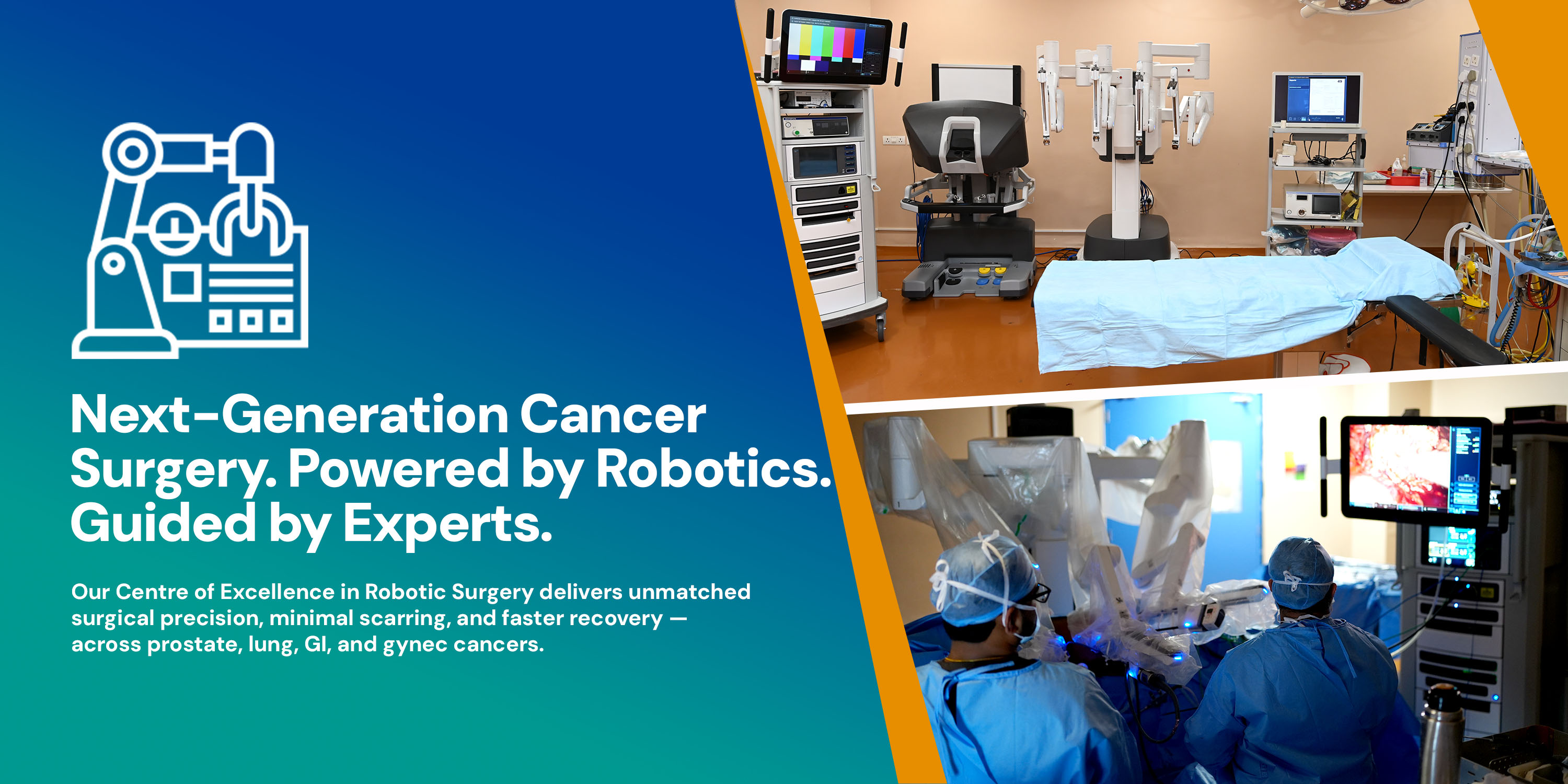
Robotic-assisted surgery, often referred to as robotic surgery, is a cutting-edge approach in oncology that enhances the precision and minimally invasive nature of cancer treatments. This technique employs sophisticated robotic systems to assist surgeons in performing intricate procedures to remove cancerous tissues through small incisions, rather than traditional large open surgeries.
It is primarily a form of minimally invasive surgery, similar to laparoscopy, where the surgeon operates via tiny "keyhole" ports while viewing the operative field on high-resolution monitors.
The robotic system does not operate autonomously; instead, it translates the surgeon's hand movements into precise actions within the patient's body. From a dedicated console, the surgeon views a magnified, three-dimensional (3D) image of the surgical site. Specialized instruments, controlled by the robot, offer greater dexterity and range of motion than the human hand alone, allowing for meticulous dissection and removal of tumors while sparing healthy tissues.
The da Vinci Surgical System, particularly the da Vinci X model, is the most widely used platform globally for oncologic procedures. It provides advanced imaging, improved instrument control, and ergonomic benefits that are especially valuable in complex cancer surgeries. At our Center, we leverage this technology to achieve optimal cancer control, reduce recovery time, and improve quality of life for patients.
Robotic surgery in oncology integrates three key components that function seamlessly together
This ergonomic workstation allows the surgeon to sit comfortably while viewing a high-definition, 3D image of the tumor and adjacent structures, magnified up to 10-12 times. This enhanced visualization enables clear identification of tumor boundaries, blood vessels, nerves, and organs, which is crucial for precise cancer excision and minimizing damage to surrounding tissues.
Positioned beside the patient, this cart features multiple robotic arms (typically four) fitted with specialized instruments. These "wristed" tools provide seven degrees of freedom—allowing bending, rotating, and articulating up to 540 degrees—far surpassing human wrist capabilities. They eliminate hand tremors and enter the body through small incisions (usually 8-12 mm), enabling delicate maneuvers in confined spaces.
This interface converts the surgeon's movements at the console into real-time, scaled actions of the instruments (e.g., 1:1, 3:1, or 5:1 ratios for fine control). Additional features, such as Firefly fluorescence imaging using near-infrared technology, illuminate blood flow and critical structures, aiding in tumor delineation and safe navigation.
The system also incorporates voice-activated controls and motion scaling, allowing surgeons to maintain focus and comfort throughout the procedure. This setup ensures sub-millimeter accuracy, which is particularly beneficial in oncology for achieving complete tumor removal while preserving vital functions.
Robotic-assisted surgery offers evidence-based benefits supported by extensive clinical research, including randomized trials and meta-analyses from leading institutions
Small incisions minimize pain, scarring, and disruption to the body. Patients often report lower pain levels post-surgery, requiring fewer opioids. Hospital stays are typically shortened—many are discharged within 1-3 days, compared to 5-10 days for open surgery—facilitating quicker return to daily activities and work. Studies show improved quality-of-life scores in the early postoperative period.
Magnified views and precise vessel sealing reduce intraoperative bleeding by 40-60% in procedures like radical prostatectomy or pancreatic resections, as evidenced by comparative analyses. This lowers the risk of transfusions, anemia, and related complications, promoting faster healing.
Robotic approaches demonstrate reduced incidences of infections, wound dehiscence, deep vein thrombosis, and pulmonary issues. For instance, in gynecologic oncology, complication rates are approximately 5-10% versus 15-25% for open surgery, per registry data from institutions like Cleveland Clinic. The minimally invasive technique also decreases the likelihood of long-term issues like incisional hernias.
Robotic surgery achieves high rates of complete tumor resection (R0 margins) and accurate staging. In prostate cancer, it reduces positive surgical margins by 20-30% in high-risk cases, leading to better disease-free survival. Meta-analyses indicate 3-5-year survival rates equivalent to or exceeding open surgery for colorectal and esophageal cancers, with enhanced lymph node yields (e.g., 20-30 nodes in thoracic procedures) for precise staging.
Nerve-sparing techniques in prostatectomy preserve continence and sexual function in up to 80-90% of eligible patients at 12 months. In head and neck cancers, transoral robotic surgery (TORS) maintains swallowing and speech without facial incisions. For gynecologic procedures, it better safeguards bladder and bowel integrity.
By enabling thorough resections and staging, robotic surgery may allow some patients to avoid or minimize chemotherapy/radiation, reducing side effects like fatigue or neuropathy—particularly relevant for younger or frail individuals, as noted in guidelines from the National Comprehensive Cancer Network (NCCN).
These benefits are most pronounced in high-volume centers with experienced teams, where outcomes align with benchmarks from global leaders in oncology.
Our multidisciplinary program applies robotic surgery across a broad spectrum of malignancies, drawing on protocols from global leaders in oncology
Prostate, Kidney, Bladder: In the Department of Urologic Oncology at Sri Shankara Hospital, we are at the forefront of robotic surgery, routinely performing advanced procedures such as Retzius-sparing prostatectomy, complex nephron-sparing surgeries, and intracorporeal urinary diversions.
Our department is recognized as a center of excellence in robotic uro-oncology and hosts numerous consultants for observership programs.
Ideal for rectal tumors, enabling precise total mesorectal excision with R0 rates >95% and low local recurrence (5-10% at 5 years). Multivisceral resections extend options for advanced disease.
Cervical, Endometrial, Ovarian: Robotic hysterectomy and lymphadenectomy yield 5-year survival rates of 90-95% for early-stage disease, with hospital stays under 2 days and low complication rates (5-8%).
TORS for oropharyngeal tumors (e.g., HPV-related) avoids jaw-splitting incisions, with 90% of patients resuming normal diet within weeks and survival rates matching traditional methods.
Esophageal, Gastric: Robotic esophagectomy and gastrectomy provide thorough lymph node dissection (average 25-35 nodes) and 80-90% 3-year survival in resectable cases.
Pancreas, Liver, Biliary: Robotic Whipple procedures for pancreatic adenocarcinoma achieve R0 margins in 85-90% of cases, with shorter stays (5-7 days) and fewer fistulas than open surgery. Hepatic resections are feasible for selected metastases.
Lung, Mediastinal: Lobectomy and segmentectomy for non-small cell lung cancer match video-assisted thoracic surgery (VATS) outcomes, with enhanced nodal staging per NCCN guidelines.
We tailor approaches based on tumor board reviews, ensuring alignment with evidence from leading guideline agencies to offer best practice approach to our patients.
While robotic surgery advances cancer care, it is important to discuss potential risks transparently
Occurs in 1-5% of cases due to adhesions, bleeding, or anatomy; this prioritizes safety over minimally invasive intent.
Include bleeding, infection, thrombosis, and anesthesia effects, though rates are lower (2-5%) than open surgery. Patients with obesity, prior surgeries, or comorbidities may face higher risks.
Setup may add 30-60 minutes, but overall duration is often comparable or shorter for complex cases.
Outcomes improve with >50 cases per surgeon annually; we recommend verifying credentials.
Higher initial costs may be offset by reduced complications, but insurance coverage varies.
Depend on cancer stage and patient factors; not all achieve full recovery of functions like continence.
Long-term data continues to evolve, with ongoing studies monitoring recurrence and quality of life.
Our process mirrors best practices from leading institutions, emphasizing education and support
Includes imaging (CT/MRI/PET), tumor board review, and assessments (bloodwork, cardiac/pulmonary tests). Counseling covers expectations, risks, and alternatives.
Under general anesthesia, the procedure lasts 2-6 hours. Patients recover in a monitored unit, with pain control and early mobility.
Hospital stay: 1-5 days for most; 5-10 for complex cases. Home recovery involves gradual activity resumption, with follow-up at 1-2 weeks.
Includes surveillance imaging, functional assessments, and coordination with oncology teams for adjuvant therapies.
At Sri Shankara Cancer Foundation's Center of Excellence in Robotic Surgery for Oncology, located at Sri Shankara Hospital, we deliver compassionate, evidence-based care using the da Vinci X system. Our fellowship-trained surgeons, high-volume expertise, and adherence to guidelines ensure outcomes comparable to global leaders.
In particular, our program leads in innovative robotic techniques and serves as a training hub for observerships. Multidisciplinary collaboration, advanced imaging, and patient-focused support optimize results, minimizing trauma while maximizing cancer control and quality of life.
We invite consultations to discuss personalized options.