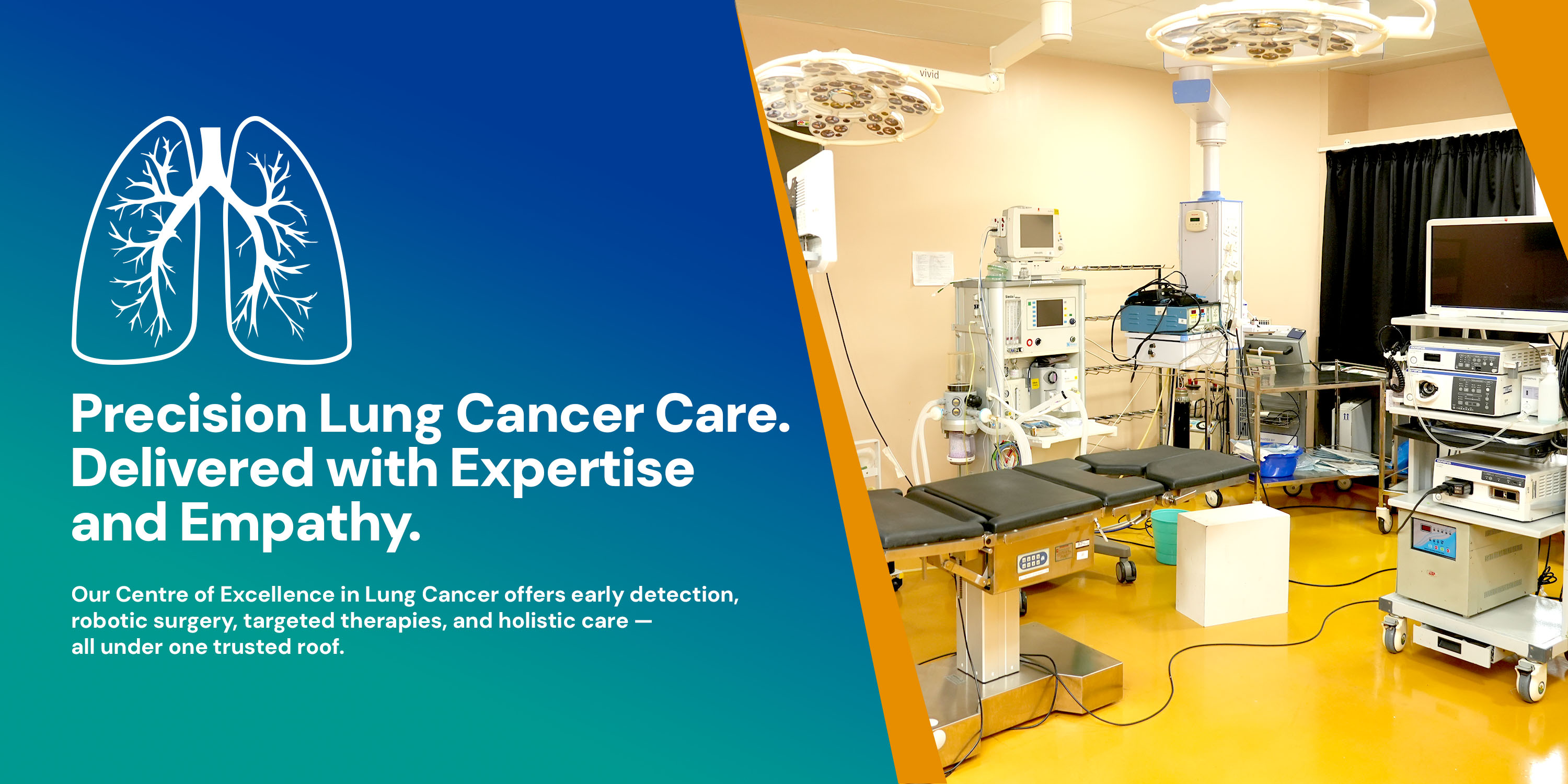
The Sri Shankara Cancer Foundation's Centre of Excellence in Lung Cancer is committed to delivering life-changing, evidence-based care for patients with lung-related diagnoses. We understand that a lung cancer diagnosis can be overwhelming. Our integrated team of specialists offers compassionate care and comprehensive guidance through every step of the treatment journey, combining the latest medical innovations with a supportive environment, ensuring personalized attention for every patient.
Our integrated approach encompasses five core service pillars:
Early detection of lung cancer fundamentally transforms patient outcomes. When identified at early stages, five-year survival improves significantly from 18% to 64% compared to advanced-stage disease. Our screening program is specifically designed for individuals at high risk based on their age and smoking history.
We follow internationally recognized, evidence-based screening criteria, which recommend annual low-dose computed tomography (LDCT) screening for high-risk adults. This proven approach has been shown to reduce lung cancer mortality by approximately 20% in this population.
Our protocol utilizes optimized low-dose CT imaging with minimal radiation exposure to maintain diagnostic accuracy. All screening findings are reported using a standardized system, ensuring clear, consistent interpretation and management recommendations.
Incidental lung nodules are frequently discovered during imaging performed for other reasons, with an estimated 1.6 million new nodules identified annually. Specialized evaluation is critical.
Our Lung Nodule Clinic provides a comprehensive assessment using a structured risk-stratification protocol that guides the appropriate follow-up schedule. Low-risk nodules may require follow-up imaging in 12 months, while higher-risk lesions necessitate closer surveillance or definitive diagnostic evaluation. This systematic approach prevents both unnecessary procedures and harmful delays in diagnosing malignancy.
When diagnostic tissue sampling is required, our clinic coordinates seamless referral to advanced interventional procedures (outlined below), minimizing delays and reducing the number of procedures a patient must undergo.
Our Interventional Pulmonology Program employs cutting-edge bronchoscopy technologies to safely diagnose and treat complex lung lesions:
By combining diagnostic bronchoscopy with advanced surgical capability in a unified procedure, eligible patients benefit from fewer appointments, faster diagnostic answers, reduced exposure to anesthesia, and accelerated treatment planning.
For patients with central airway obstruction from lung cancer, interventional bronchoscopy offers minimally invasive therapeutic options including endobronchial resection and brachytherapy. These approaches effectively alleviate airway obstruction, improve breathing, reduce bleeding, and enable patients to proceed with additional systemic treatments. Studies show that patients receiving this treatment achieve survival outcomes comparable to patients without airway involvement.
Surgical Resection for Cure: Surgery remains the most effective treatment for early-stage lung cancer and offers the opportunity for cure. Our thoracic surgical program, led by experienced specialists, offers both traditional open techniques and advanced minimally invasive approaches tailored to each patient's unique characteristics.
This advanced platform allows surgeons to perform complex thoracic procedures—including lobectomy, segmentectomy, and pneumonectomy—through small incisions with exceptional precision. Robotic assistance provides three-dimensional visualization, improved maneuverability, and superior stability compared to conventional video-assisted surgery (VATS).
Comparative evidence demonstrates that robotic-assisted approaches yield several advantages:
For early-stage lung cancer, robotic VATS pneumonectomy demonstrates a high success rate with a very low complication rate. Hospital stays average 3–7 days with substantially less blood loss than open surgery.
For complex cases requiring extended lobectomy (resection across multiple lobes or with chest wall involvement), our experienced surgical team can perform these demanding procedures via minimally invasive approaches. Recent analysis confirms that minimally invasive extended lobectomy achieves equivalent outcomes to open surgery—including complete tumor removal and long-term survival—while maintaining the benefits of minimally invasive technique.
Prevention as Foundation: Smoking tobacco remains the leading preventable cause of lung cancer, yet quitting at any point provides substantial benefit.
Our integrated smoking cessation program combines evidence-based behavioral counseling, pharmacologic support, and ongoing monitoring to maximize the likelihood of sustained abstinence. The program is available to all screening participants and cancer patients at any stage of treatment.
Impact on Outcomes: The evidence is compelling—combining smoking cessation with lung cancer screening provides dramatically amplified benefits, with data demonstrating a combined 38% reduction in lung cancer mortality. Even for patients diagnosed with lung cancer, smoking cessation improves treatment tolerance, reduces treatment-related toxicity, and enhances overall health outcomes.
For every quit attempt, there is approximately a 5–10% success rate for permanent cessation, emphasizing the value of structured program support.
Beyond diagnosis and surgical resection, our Centre offers access to comprehensive multimodal therapies guided by multidisciplinary team expertise:
Modern lung cancer treatment is increasingly driven by tumor biology and molecular characteristics. Our Centre coordinates comprehensive molecular testing to assess for specific genetic alterations, including:
For patients with specific tumor markers, immune checkpoint inhibitors reactivate the body's anti-cancer immune response. These agents have dramatically improved survival in advanced lung cancer by blocking pathways that cancer cells use to evade immunity.
For lung cancers with specific molecular drivers, targeted therapies provide superior response rates and improved survival compared to chemotherapy. Recent advances include new agents for resistant mutations and combination regimens that enhance benefit.
For patients with early-stage lung cancer who are medically inoperable or decline surgery, SBRT delivers highly focused, high-dose radiation using advanced targeting and planning. Clinical evidence demonstrates that SBRT achieves high three-year primary tumor control rates and is a preferred treatment option for early-stage lung cancer, especially in patients with high surgical risk.
For more advanced cancers of the lung, combined modality treatment with chemoradiation and immunotherapy have improved survival. Advanced technique like IGRT takes into consideration the movement of the tumour with respiration and targets only the tumour and avoiding dose to the normal critical structures like heart and spinal cord. This precise radiotherapy allows for increasing the dose to the cancer thus improving cure rates.
What fundamentally distinguishes our Centre is our structured multidisciplinary team (MDT) approach. Instead of sequential consultations with individual specialists, our experts regularly convene to collaboratively develop integrated treatment recommendations tailored to each patient's unique clinical situation.
Research consistently demonstrates that MDT care:
Quality standards ensuring effective MDT include regular meeting frequency, standardized documentation, and direct communication of the care plan to the patient.
da Vinci robotic-assisted surgery with three-dimensional visualization and enhanced precision enables complex resections with superior lymph node dissection and reduced patient complications compared to traditional approaches.
For eligible patients, combining diagnostic bronchoscopy and definitive surgical intervention under unified anesthesia reduces healthcare visits and accelerates treatment planning.
Systematic biomarker assessment enables precise patient stratification and selection of targeted therapies and immunotherapies most likely to benefit individual patients.
We recognize that smoking cessation is integral to lung cancer prevention and treatment success, with structured programs available to all patients.
Every patient deserves clear answers, respectful communication, and active participation in treatment decisions. Our Centre emphasizes:
Streamlined scheduling minimizing waiting time between diagnostic findings and specialist evaluation.
Medical information presented in understandable language, with visual aids and written materials supporting informed decision-making.
Unified scheduling reducing multiple visits and the provider coordination burden on patients and families.
Addressing not only cancer treatment but also symptom management, nutritional support, psychological wellness, and quality-of-life concerns.
Our Centre operates within NABH-accredited infrastructure, meeting over 600 objective standards spanning admission protocols, operative procedures, postoperative care, and follow-up coordination. This ensures that every patient benefits from systems designed to optimize safety, reduce errors, and enhance outcomes at every step of their care journey.
All our treatment recommendations are aligned with current international oncology guidelines from leading global bodies (including NCCN, ESMO, ASCO, ASTRO, and WHO), ensuring that our patients receive evidence-based care reflecting global best practices.
If you or a loved one requires lung cancer screening, nodule evaluation, or comprehensive treatment planning, we invite you to contact our Centre. Our team is prepared to answer your questions, coordinate all necessary evaluations, and develop a personalized care plan designed for your individual needs.