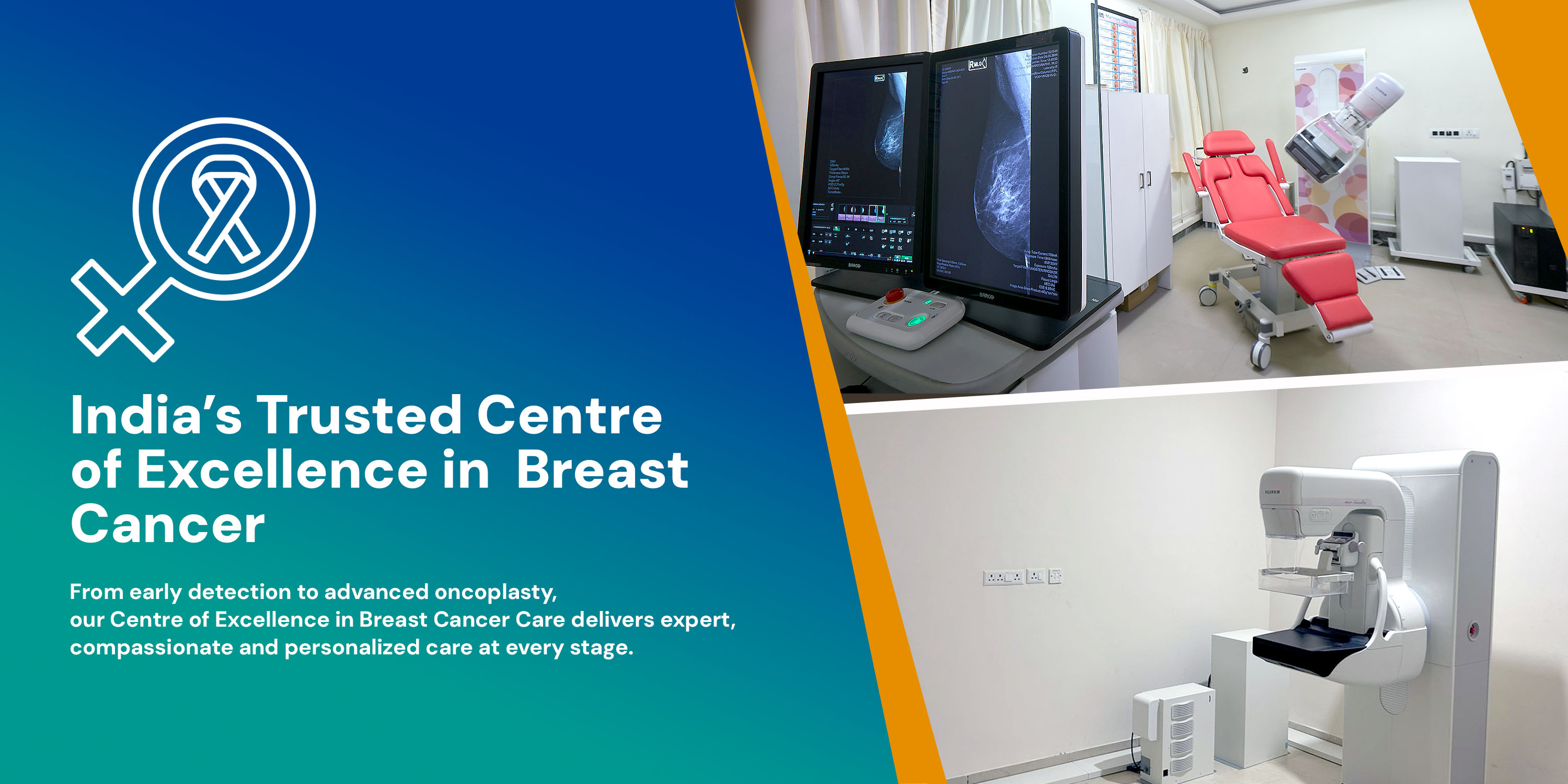
Welcome to the Breast Cancer Centre of Excellence, a comprehensive, multidisciplinary program dedicated to providing personalized, evidence-based diagnosis, treatment, and care. Our mission is to advance patient outcomes and enhance quality of life through shared decision-making by a team of world-class experts.
Your care is managed by a dedicated team of specialists who work together seamlessly in our institute, including:
This integrated model ensures that every patient benefits from expert consensus on the optimal treatment strategy, leading to improved outcomes, faster treatment initiation, and enhanced quality of life throughout your Breast cancer journey.
Early detection is key. We use state-of-the-art diagnostic imaging to detect breast cancer at the earliest, most treatable stages.
Captures multiple layers of breast tissue for a clear, 3D image. Significantly improves cancer detection, especially in dense breast tissue, and reduces false-positive results.
A gold-standard screening tool using digital X-rays to monitor tissue changes over time.
Uses magnetic fields and radio waves to assess the extent of known cancer, screen high-risk women, and evaluate the opposite breast.
Uses sound waves to distinguish between solid masses and fluid-filled cysts; often used for guiding biopsies.
Minimally invasive needle biopsies performed under ultrasound, mammographic, stereotactic guided for precise diagnosis with less discomfort and faster recovery.
Our highly trained breast surgeons prioritize both oncological safety and cosmetic outcomes, offering advanced techniques:
Removes the tumour and a margin of healthy tissue while preserving the breast. Typically combined with radiation therapy, achieving long-term cancer control equivalent to mastectomy in selected patients. We provide intraoperative margin assessment through frozen section.
Removes all breast tissue while preserving the skin, nipple, and areola for superior cosmetic outcomes and maintaining a natural breast appearance.
Minimally invasive technique to identify and remove only the first lymph node(s) likely to contain cancer. This minimizes the risk of lymphedema while providing accurate staging. We have all 3 techniques (ICH, Methylene blue, Gamma probe) available at our center.
Performed when cancer has spread to regional lymph nodes to reduce the risk of recurrence.
An innovative microsurgical technique performed at the time of axillary dissection to reconnect lymphatic channels, reducing the incidence and severity of lymphedema.
A mastectomy involves removal of the entire breast tissue for cancer treatment or risk reduction.
Skin-sparing mastectomy preserves most of the breast skin, while nipple-sparing mastectomy preserves both the skin and nipple-areola complex, enabling superior cosmetic outcomes when combined with immediate reconstruction, without compromising oncologic safety in selected patients.
Breast-conserving surgery removes the cancerous tumor along with a rim of surrounding healthy tissue, while preserving most of the breast.
It is typically followed by radiotherapy and offers survival outcomes equivalent to mastectomy in early-stage breast cancer.
SLNB involves removal of the first few lymph nodes that drain the breast to assess cancer spread, minimizing surgical morbidity.
ALND involves removal of multiple axillary lymph nodes and is performed when nodal involvement is confirmed or extensive, to achieve local disease control.
Targeted axillary dissection is an advanced technique that selectively removes previously biopsy-proven positive lymph nodes along with sentinel nodes.
It is commonly used after neoadjuvant chemotherapy to accurately stage the axilla while reducing complications such as lymphedema.
Oncoplastic surgery combines cancer removal with plastic surgical techniques to preserve or improve breast shape and symmetry.
It allows wider tumor excision with better cosmetic outcomes and may include volume displacement or replacement techniques, often with simultaneous contralateral breast symmetrization.
Microdochectomy involves removal of a single affected milk duct, usually performed for pathological nipple discharge.
Complete duct excision removes all major ducts beneath the nipple and is indicated when multiple ducts are involved or malignancy cannot be ruled out.
We offer a comprehensive range of breast reconstruction and aesthetic procedures designed to restore form, confidence, and emotional well-being after breast cancer treatment. Our approach is personalized—balancing oncologic safety with natural appearance and long-term comfort.
Often regarded as the gold standard in tissue-based breast reconstruction, the DIEP flap uses the patient's own skin and fat from the lower abdomen to recreate the breast. Because abdominal muscles are preserved, this technique offers a more natural feel, quicker recovery of core strength, and high long-term patient satisfaction.
Implant-based reconstruction uses silicone or saline implants to restore breast shape, either immediately or in a staged manner. Techniques such as tissue expansion and acellular dermal matrices allow for optimal implant positioning, symmetry, and aesthetic outcomes with shorter operative time.
The LD flap uses muscle, skin, and fat from the upper back to reconstruct the breast, often in combination with an implant. It is a reliable option for patients who are not candidates for abdominal flaps or who have received prior radiation therapy.
This advanced microvascular procedure reconstructs the breast using abdominal tissue while preserving muscle function. In addition to creating a natural-looking breast, it provides the added benefit of abdominal contouring, similar to a tummy tuck.
A commonly chosen option where breast volume is restored using implants alone or following tissue expansion. It is suitable for select patients seeking a less extensive surgery with predictable outcomes.
Lymphovenous bypass is a microsurgical procedure that helps prevent or treat lymphedema by redirecting lymphatic fluid into nearby veins. When performed alongside breast cancer surgery, it can significantly reduce long-term arm swelling and improve quality of life.
Personalized treatment plans are designed based on your individual tumour biology and genetic markers.
Carefully selected regimens to slow or stop cancer cell growth, with continuous monitoring to optimize effectiveness and manage side effects.
Drugs (e.g., Herceptin, CDK4/6 inhibitors) that specifically attack cancer cells with particular characteristics (like HER2-positive or hormone receptor-positive cancers), often with fewer side effects than traditional chemotherapy.
Blocks the effects of hormones that fuel cancer growth (e.g., tamoxifen, aromatase inhibitors) for hormone receptor-positive cancers, used in adjuvant and metastatic settings.
Harnesses your body's immune system (e.g., checkpoint inhibitors like pembrolizumab) to destroy cancer cells, particularly for triple-negative and high-risk disease.
Regimens that combine different therapies (chemotherapy with immunotherapy, targeted therapy with endocrine therapy, etc.) to maximize cancer control.
We use advanced technologies to deliver highly precise radiation therapy while minimizing exposure to healthy tissues.
Advanced planning techniques deliver high doses of energy beams to the tumour.
Allows radiation oncologists to visualize the tumour in real-time during treatment using MRI, enabling adaptive treatment and maximizing precision.
Delivers high-dose radiation in very few sessions with exceptional precision, valuable for early-stage and limited metastatic disease.
Internal radiation used as a boost or primary treatment in selected patients, allowing for shorter overall treatment duration.
Safely delivers additional external beam radiation therapy using modern techniques for locally recurrent breast cancer.
APBI targets radiation only to the part of the breast where the tumor was removed, rather than the entire breast.
It significantly reduces treatment duration and side effects, making it an effective option for selected early-stage breast cancer patients.
We address the full scope of your needs—physical, emotional, social, and spiritual.
Dedicated nurse navigators coordinate appointments, explain treatment, serve as a single point of contact, and connect you with resources, significantly reducing anxiety.
Individual and group counseling, support groups, and mental health referrals for anxiety, depression, and cancer-related distress.
Personalized nutrition counseling by registered dietitians to support recovery, manage side effects, and promote long-term wellness.
Physiotherapy and occupational therapy to manage pain, prevent lymphedema, and restore function.
Dedicated clinic focused on advanced systemic therapies, symptom management, and psychosocial support to maintain quality of life for patients with stage IV disease.
Specialized care addressing unique challenges like fertility preservation, psychosocial support, and cosmetically-sensitive surgical planning.
Assess personal and family history, discuss risks/benefits of testing (BRCA1, BRCA2, etc.), interpret results, and develop surveillance strategies for high-risk individuals and their families.
Active participation in clinical trials offers eligible patients access to cutting-edge therapies and contributes to advancing cancer science.
Ongoing monitoring after treatment, including annual mammography, screening for other cancers, and proactive management of long-term treatment effects (lymphedema, fatigue, bone health).
Contact us to schedule a rapid-access appointment with a breast specialist.
We welcome the opportunity to review your records and provide an independent expert assessment of your diagnosis and treatment recommendations.
We facilitate smooth care transitions and maintain communication with your referring physicians.